
RTP vs Volatility: What Is the Difference in Slots?
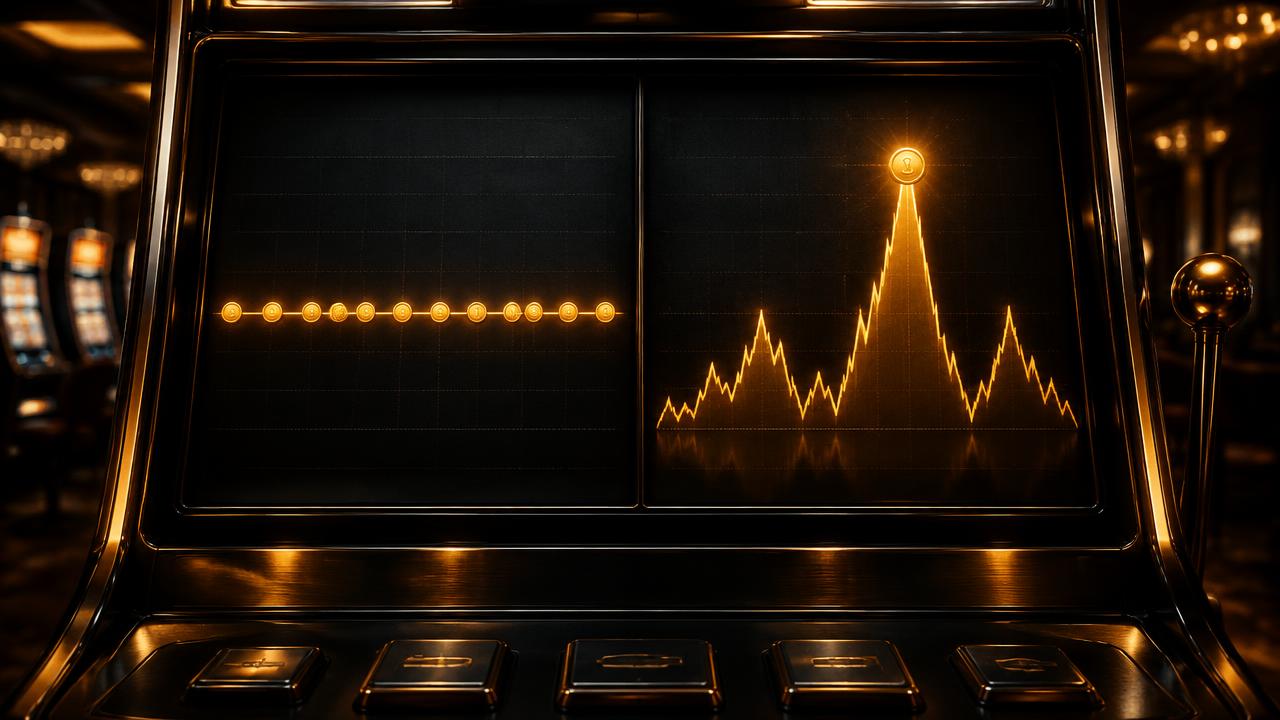
RTP is the theoretical share of stakes a slot returns over millions of spins; volatility is how that return is spread out. Learn the difference, with examples, and what neither can tell you.
The short answer
RTP and volatility are two different properties of a slot's maths. RTP (return to player) is the theoretical share of all stakes a game is designed to return as prizes over a very large number of spins — a 96% RTP means a theoretical average return of 96 per 100 staked, with a 4% house edge. Volatility describes how that return is distributed: low volatility spreads it into smaller, more even prizes, while high volatility concentrates it into rarer, larger hits. Key facts: RTP answers 'how much on average', volatility answers 'in what pattern'; neither predicts a single session; both are set by the provider and verified through testing. 18+ only.
What RTP tells you
RTP is a long-term average measured over millions of spins. It tells you the size of the house edge — 100% minus the RTP — and nothing about timing. A 96% RTP slot is not 'due' to pay after a losing run, and it does not return 96% of any one player's budget. Our RTP guide covers the figure in detail, including why the same slot can have different RTPs at different casinos.
What volatility tells you
Volatility — sometimes called variance — describes the spread of results around that average. A low-volatility slot is designed to pay smaller prizes relatively evenly; a high-volatility slot is designed to pay rarely but in larger amounts, often with much of the return sitting in a bonus round. Our volatility guide explains low, medium and high designs with a worked example.
Side by side: the key differences
Think of RTP as the size of the pie and volatility as how it is sliced. Two slots can share a 92% RTP and feel nothing alike: one pays small prizes often, the other pays almost nothing for long stretches and then a large multiple of the stake. RTP is usually published as an exact percentage; volatility is usually a label (low, medium, high) or a scale. RTP is comparable across games; volatility is a design preference, not a measure of value.
Four combinations, four different games
High RTP + low volatility: smaller house edge with a steadier ride — Starburst is a classic low-volatility example. High RTP + high volatility: a lower edge on paper, but long quiet stretches are normal. Low RTP + low volatility: frequent small prizes but a larger house edge. Low RTP + high volatility: the toughest combination — a big edge and a swingy ride, as in many jackpot slots. Every combination still has a house edge, and the expected long-term result of playing is a loss.
A worked example
Imagine two slots, both staked at 1 per spin. Slot A has a 96% RTP and low volatility; Slot B has a 92% RTP and high volatility. Over millions of spins, Slot A is designed to return more on average. But in a single evening, Slot B might produce a 500x bonus while Slot A never pays more than 20x — or Slot B might return nothing at all. The RTP gap only shows over a volume of play no individual session reaches, and either game can lose your whole stake.
Which matters more?
For comparing games over the long term, RTP is the more concrete number: a higher published RTP means a lower theoretical house edge. For the feel of a session — how quickly a budget can swing up or down — volatility matters more. Neither makes winning more likely in any given session, and no combination of the two removes the risk of losing. If you choose between two games you enjoy equally, the higher-RTP one has the lower theoretical edge; the volatility is a matter of preference.
Where to find both figures
Open the game and check the info, help or paytable screen — licensed casinos are generally required to disclose the RTP, and many providers state volatility there or on their website. Every review on this blog lists the RTP configured at Moolzy and the volatility listed for each game, and the high-RTP slots list collects published RTP figures in one place. If a figure cannot be found, treat that as a reason to be cautious.
Common myths about both
Myth one: high RTP means you will win — it is a long-term average, not a session prediction. Myth two: high volatility means a big win is coming — spins are independent and the random number generator has no memory. Myth three: a low-volatility slot cannot lose — every slot has a house edge. Myth four: changing your stake changes the RTP or volatility — stake size changes the amounts at risk, not the game's maths.
Playing with both in mind
Use RTP to compare the theoretical cost of games and volatility to pick a pacing you are comfortable with — then treat both as background information, not a strategy. Set a budget you can afford to lose before you play, take breaks, and never chase losses. Free demos on many Moolzy slots are a way to learn the rules and see the pacing; demo results do not indicate how often features or wins occur in real-money play. 18+ only. If gambling stops being fun, use the deposit limits and self-exclusion tools in your account and seek support from organisations such as BeGambleAware.
Frequently asked questions
What is the difference between RTP and volatility?
RTP is the theoretical share of stakes a slot returns over millions of spins; volatility is how that return is distributed. A 96% RTP says how much on average; high or low volatility says whether it arrives in small even prizes or rare large ones.
Is a high-RTP, high-volatility slot a good choice?
It has a lower theoretical house edge than a low-RTP game, but high volatility means long stretches without a prize are normal. No combination of RTP and volatility makes winning more likely in a session or removes the risk of losing your stake.
Can a slot have high RTP and low volatility?
Yes. RTP and volatility are independent properties — a game can pair a high published RTP with a low-volatility design, or any other combination. Check the game info panel for the figures that apply where you play.
Which is more important, RTP or volatility?
For long-term comparison, RTP is the concrete number: higher RTP means a lower theoretical house edge. For how a session feels, volatility matters more. Neither predicts individual results.
Does a 96% RTP slot pay more than a 92% one?
Over a very large number of spins, it is designed to return more on average. In any single session the difference is invisible — results vary widely in both directions, and both games can lose your whole stake.