Online Blackjack Review & Strategy Guide: Lower the House Edge to 0.5%
Our blackjack guide covers rules, basic strategy terminology and how variants differ. House edges depend on the rules and player decisions; no approach guarantees a win.
Blackjack at a glance
Blackjack's house edge depends on the rules and player decisions. A figure of around 0.5% is commonly quoted for certain rules under mathematical assumptions about decisions — equivalent to an average theoretical loss of 50 cents for every 100 wagered. The corresponding figures are 2.70 for European roulette and 4–8 for slots with RTPs of 92–96%. These are long-term theoretical averages, not predictions of individual results. Moolzy offers digital blackjack and live dealer tables.
Rules in 60 seconds
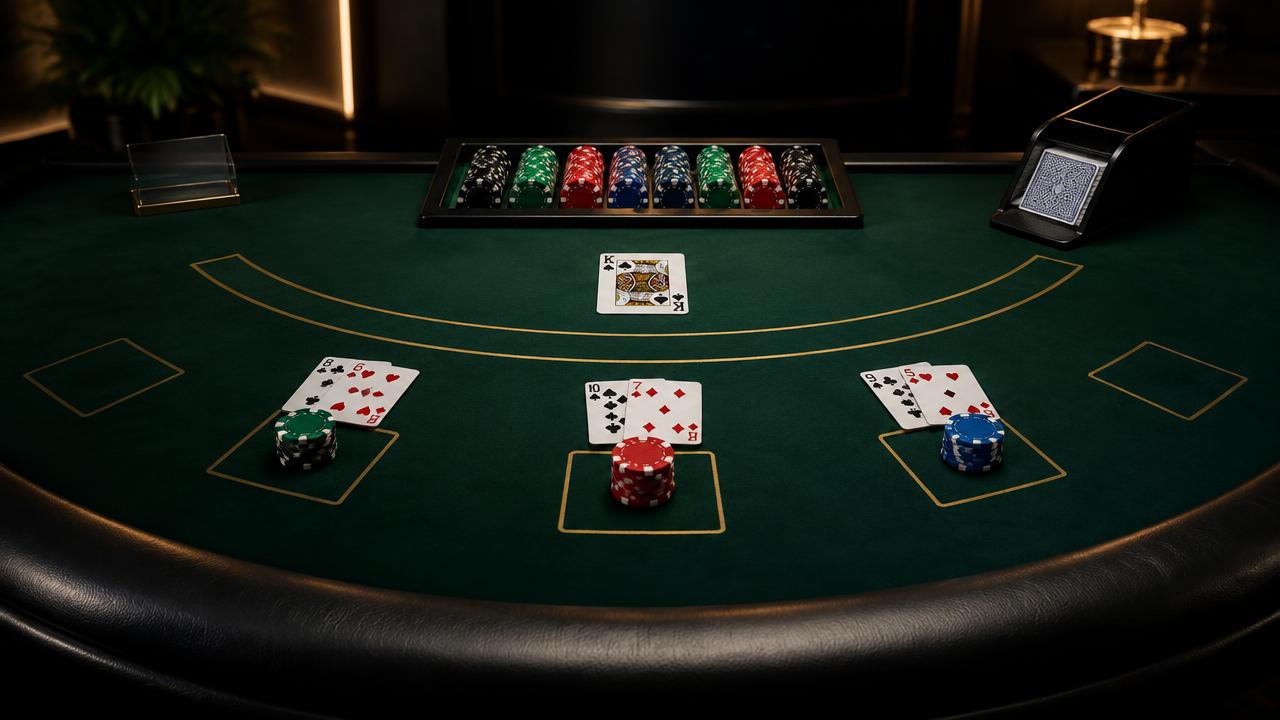
The aim is to get closer to 21 than the dealer without going over. Cards 2–10 are face value, picture cards are 10 and aces count as 1 or 11. You and the dealer each get two cards; available actions may include hit (take another card), stand (keep your hand), double down (double your bet for exactly one more card) or split a pair into two hands. Going over 21 is a bust. A two-card 21 — an ace plus a ten-value card — is a blackjack and pays 3:2 at tables with that payout rule.
Basic strategy: what the term means
Basic strategy refers to mathematical charts of hand decisions based on the player's cards, dealer upcard and table rules. Published house-edge estimates of about 0.5% generally assume particular rules and decisions; other assumptions can produce estimates above 2%. These figures are not forecasts of individual results, and charts do not guarantee wins. Rules on using reference charts vary by operator.
Double down and split rules
Doubling down means doubling the initial bet in exchange for exactly one additional card. Splitting separates a pair into two hands, usually with an additional bet equal to the original stake. Restrictions on eligible hands, further splits and doubling after a split vary by table. Both actions involve additional money at risk.
Variants and payout rules
Some tables pay 3:2 on blackjack; others pay 6:5. This difference affects the house edge, as do rules on whether the dealer stands on soft 17 and whether doubling after a split is permitted. Side bets such as Perfect Pairs or 21+3 use separate paytables, with house edges that can run 4–10% depending on the version. Insurance is a separate bet that the dealer has blackjack and has its own house edge.
Live blackjack vs digital blackjack
Digital blackjack uses a software interface, while live blackjack streams a dealer using physical cards. Live video generally uses more mobile data. Rules, payout tables and house edges depend on the specific game rather than whether it is digital or live.
Budget and time limits
Set a budget or deposit limit, gamble only what you can afford to lose, and take breaks. No stake size or betting system makes blackjack safe or guarantees protection from losses. Increasing bets after losses increases the amount of money at risk.
Our verdict
Blackjack is available in digital and live dealer formats, with rules and payout tables that vary between games. Basic strategy is a mathematical concept, not a guarantee of winning. European roulette has different rules and a theoretical house edge of 2.70%. Both games involve a risk of losing money.
Pros
- Published house-edge estimates around 0.5% under specific rules and decision assumptions
- Player decisions form part of the game
- Defined card values and hand rules
- Reference charts describe the basic strategy concept
- Available as digital and live dealer games
Cons
- House-edge estimates depend on rules and assumptions about decisions
- 6:5 tables pay less for blackjack than 3:2 tables
- Side bets and insurance have separate house edges that can exceed the main game's
Classic Blackjack FAQ
What does blackjack basic strategy mean?
Basic strategy refers to mathematical charts of hand decisions for particular table rules. The often-quoted house edge of around 0.5% assumes specific rules and decisions. It is a long-term theoretical figure, not a guarantee or a prediction of individual results.
What is insurance in blackjack?
Insurance is a separate side bet that the dealer has blackjack. It has its own house edge and does not make the main bet safe or prevent losses.
What is the difference between 3:2 and 6:5 blackjack?
A 3:2 table pays 150 for a 100 bet on blackjack; a 6:5 table pays 120, excluding the returned stake. The lower payout increases the house edge when other rules remain the same; the overall house edge depends on the full rules.
Can you count cards online?
Shuffling procedures vary. Digital blackjack may shuffle the virtual shoe after every hand, while live dealer games use their own shoe and shuffle procedures. Neither card counting nor basic strategy guarantees a win.
How does blackjack compare with roulette?
Blackjack's often-quoted house edge of 0.5% depends on specific rules and assumptions about decisions. European roulette has a theoretical house edge of 2.7%. These are long-term mathematical averages, not predictions of individual results, and both games involve a risk of losing money.